
Opening Analysis on The Lion King (1994)
- zrqai06
- Apr 20, 2024
- 3 min read

The Lion King (1994) is film based on the story of an African domain which is inhabited by a pride of lions. The film was directed by Roger Allers and Rob Minkoff, making it the 2nd highest grossing film of all time. This is one of those films whose target audience is all age groups and isn't limited to a set of people. I've loved this film from childhood, and from the very beginning, even though it's not your typical film opening sequence, it had most viewers hooked and in awe. The opening scene is a masterpiece with regard to animation and is further enriched by the musical components. The music used in the first couple of minutes can be classified as African tribal music, which perhaps symbolizes the family and community. This can also be justified as the film is really easy to follow through and can be understood by all. The music used in the background is non-diegetic and goes and ties up with the visuals pretty well.
To start off, the opening scene presents an establishing shot featuring the horizon with the sun rising.

This single shot proves to be highly effective as it not only reveals the setting of the film but also gives insights into the characters and the upcoming events. Furthermore, it gives the audience a sense of time, as the emerging sun suggests the start of a new day and hints at the importance of the day's events due to the emphasis on the sunrise. This shot then moves onto the shot of a rhino, lifting its head in what seems like a gesture of respect towards the sun, again justifying the notion that this day is an important one. The scene continues on to show close-ups of different doing the same as what the rhino did, basically just reinforcing the fact that the new day holds much value.


Following this, the scene transitions to a close-up of a bird, depicting the bird soaring into the sky. The music after this can also be heard shifting, with the upbeat, celebratory of type music coming to a halt.The following scenes are establishing shots, which include a herd of elephant, a herd or deer, and even an aerial shot of a river. Also, the flock of birds which were leaving the frame earlier are now returning and are flying across the top of the screen. All these shots together portray that something of much importance is about to unfold and all the animals are on a journey to meet at one specific destination.
Following this, a long shot captures a giraffe and its baby walking up a hill, deepening the themes of family and community. The camera angle remains constant, but the giraffes reposition themselves, with the camera now situated behind them, providing a view over the mountain edge where the other animals have assembled and are moving about.
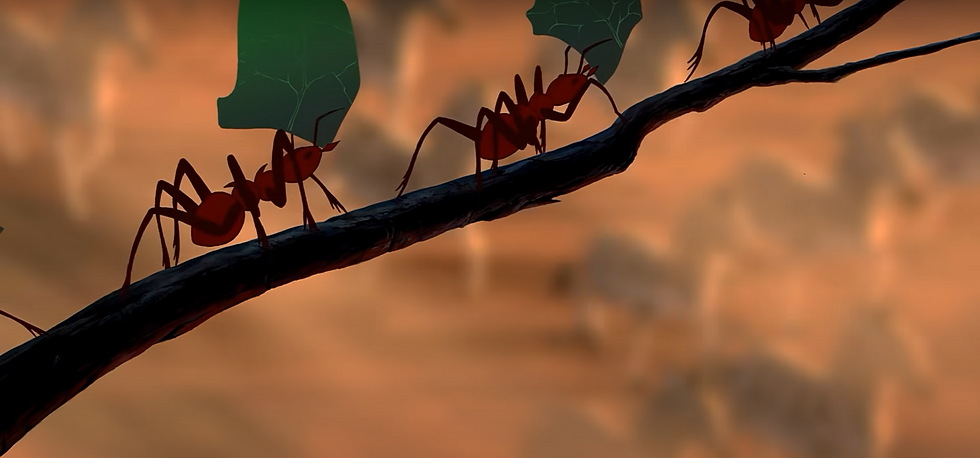
Moving ahead, a shot is provided which is really awe-inspiring as it basically tells about the sizes of animals. Initially, a close-up zooms in on a group of ants diligently transporting leaves along a branch. The focal point then shifts to the animals walking in the background, providing a perspective on the small size of the insects that were just on screen.

Moving ahead, we get a low angle shot of an elephant, emphasizing their towering presence compared to the surrounding animals. The following shots are mostly long shots that have been put to show unity among the animals. The frame then zooms into the parrots on the elephant's tusks and then when it pulls out, the entire scene which has had been anticipated from the start is now in view.

Finally, in the last moments, one shot contains of animals being seen from above as they are walking to their destination. Then there is another shot in which the camera zooms in to show the King on a big rock. At first, the camera focus is on the other animals, but gradually it shifts to the King, with the camera being at a very low angle to show the power and authority he withholds.


Comments