
Opening Analysis on Gladiator (2000)
- zrqai06
- Apr 20, 2024
- 6 min read

Gladiator (2000), an epic historical drama film, directed by Riddley Scott, has won several awards, including Best Picture and Best Actor. This type of film genre is not one I would've thought I'd like, but surely, I fell in love with the way this film is made right from the very beginning. The representation and how the history is brought to life with this film is truly on point makes the viewers really want to sit through it all and watch the entire thing, just what this opening did to me.
After the title sequence, the scene opens with tracking shot of a man's hand running over wheat crops in a field. In this shot, the hand is in focus which basically indicates that this character is one with a major role or is of some kind of importance. Going along with this shot, non-diegetic, soulful and ethereal music playing in the background can be heard which could also be termed as the usage of parallel sound as it makes the overall shot bind together with the sound complimenting the visuals. The lighting is bright and well lit which probably suggests this is shot around after the time of sunrise.

The scene then moves on to a close-up of a man. This becomes a bit abrupt and noticeable as the colour scheming in the previous shot and the shot now are really contrasting. The previous shot was all bright and sunny, probable giving out a representation of hope, and the shot present at hand has a duller colour pallet used as the background. The expressions of the man during the close-up can be interpreted as worrisome once, again juxtaposing the probable hopefulness in the previous shot. The following shot is of a bird, who according to some viewers could be seen as a symbol of hope, and when the bird flies away, it could be portrayed as hard times are ahead.

Later on, we get the first establishing shot of the film, a wide shot, which is a visual of the destination the film is set in. The barren land with the cut down trees in the front and a thick forest in the background probably suggests that whatever happened on the land in front was not a very pleasant one.

The location of the area is bold and center-aligned, with contrasting white block letters which signifies the importance of this place. The fog, or perhaps smoke present in the right-hand corner of the frame actually does add a sense of eerie to the shot in whole. Even though the visuals have changed quite a few times since the start of the opening scene, the same non-diegetic soulful music remains the same and constant till now as well.
This establishing shot progresses slightly towards the right, now having horses enter the frame, shifting the focus from the location to them. This time diegetic sounds of horses' hooves clicking on the ground and of them neighing can be heard over the non-diegetic music. This shot, then moves along to become a somewhat arial shot. This cannot be classified as a proper arial shot, as when looking at the horses and men above ground level, this is a wide angle shot, but when looking at ground level this can be said to be an arial shot.

From this shot onwards, the diegetic sounds start to become more prominent than the music in the background. Voices of several men and horses can always be heard which portrays some important tasks is at hand which needs communication and order. Following this shot, we get a couple of high angle shots of men on horses, galloping ahead. This type of camera work indicates sense of authority and power. The men on the horses can be seen as the ones in power or perhaps as the ones in control. This control could also be implied on as control on the horses as well.


Following this shot, the camera closes in to the face of some character which hasn't been on screen before this. This camera technique provides importance to the character and shows that he probably won't have a minor role in the film even though he has not been introduced as of yet. Right after this close-up, we see another man being in focus of the frame, the same man in one of the previous shots. This shot, again like the previous one is there to show importance.


The same music continues as further on we get a tracking shot, following the man through what could be supposed as his army, as all the other men are bowing down upon his arrival. This statement of respect from other men supports the claim of the previous close-ups, as he is in fact, a major character. The tracking shot, along with again, the constant music continues on to show a few close-up shots of his men, and then progresses to a wide shot, showing different men doing the different duties assigned to them.Moving on, the non-diegetic sound of music starts digressing more and more when a conversation among the man and his men break out. Plenty of over the shoulder shots have been used here, to situate the viewer, and to give them a point of view of how it would have felt like being among all this.
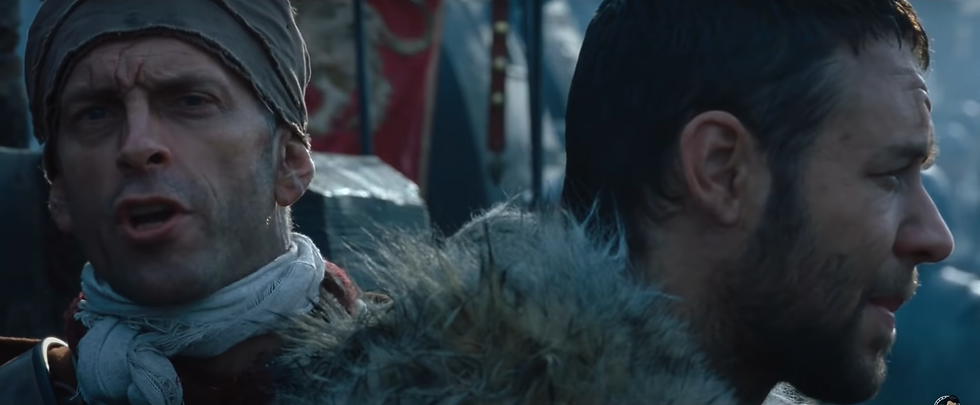


Later on, the scene turns into a wide shot showing a horse galloping towards the camera, or instead the people. The diegetic shout of a person automatically manages to make the audience anticipate and get tense. The shot is then aligned with another close-up of the man, whose expressions basically tell that this is something not very out of the usual. Progressing, we see the horse approaching the men, now closer in distance. This is shot from a very high angle or could also be termed as an arial shot. The lighting in this shot is very low-key and the added element of fog helps create a pretty sinister atmosphere overall.

The background music that was present since the first shot is the probably the only thing that has remained constant till now. It is actually amazing how contrasting this shot is with the first shot with the man in the fields. Everything, from the mood to the colour schemes juxtapose, yet nothing seems forced or abrupt. Moving forward, we get to see the horse in mid-shot and the headless man who appears to be sitting on it. The side of the horse is covered in blood which is given importance to as it contradicts with the horse's white skin to catch the eye of the audience. In this opening scene many close-ups have been shot to really make the viewers dive into the emotions of the characters as really no such action or climactic moment takes place during the first few minutes. It has really been left up to the viewers how they want to perceive the emotions displayed to them.


After this close-up shot, just as the climax is about to hit, the man who we can assume as the main character says, "...unleash hell." And that is where this opening scene ends. The final wide shot we get from the opening scene is this one.

This shot is actually a really amazing one to have as a final shot as it can be seen the first establishing shot and this last shot are mostly the same, except for the fact that there are armies on both sides now. It can also fear inducing factor if taken this way that war can really emerge in a very short time (or minutes in this film opening's case). The calmness one might have had received for the first shot is not present anymore in this final one and is probably replaced by the feeling of tense.
The film opening to Gladiator (2000) remains a favourite to me as even though one might think there is a lot going on, it still is very easy to keep up with. Also, I personally think this opening scene is tied together in a flawless way from the first shot to the last and everything goes on super smooth even though the situation at hand isn't anywhere near smooth. Also, even though the situations change quite many a times and shots changed, the non-diegetic music remaining constant also helped to add more of a sense of chronology to the whole scene.


Comments