ROUGH CUT
- zrqai06
- Apr 21, 2025
- 5 min read
So, after contemplating for a couple of hours, Rija and I decided to treat our preliminary task as our rough cut. Since we used it as a foundational edit and built our final cut by refining it with a re-shoot and re-edit, it made complete sense. Our preliminary essentially acted like a plan, exactly what a rough cut is supposed to be.
Let's go back a year now. After coming back from filming, we went to Rija's house to start on the editing. It was initially very overwhelming, as this was our first time doing something so big (yes, we thought, "OMG, there can't be anything bigger than this!" like we were editing the new blockbuster film). Yes, I had edited several videos before, but this genuinely seemed like such a big deal. The enthusiasm (and a little nervousness) turned out to have a good outcome, though.
Firstly, we started by sorting and categorizing shots on the basis of 'what looked kinda nice,' 'money shots (DEFO USE THIS),' and 'ew, what is this.' The shots that were most definitely going to be used were labeled as 1, 2, 3... but that's where it ended. Realization hit: this was going to take so long.
This is so funny actually, it really only went till 3.

Then, we used the method where we just wouldn't import the shots that we ABSOLUTELY knew we wouldn't use. Then, 1% maybe shots also went in. Perhaps not the best method, but it was a method nonetheless. And then we just dove in.
Having everything in front of us, we started experimenting. Initially, we didn't even have the opening shot planned, but since we did have a narrative in mind (thank god), it became easy to follow, with a mind map made stating 'Zara walking,' 'Zara touching flower,' 'Zara swinging from pole,' etc., and as we had this clear divide—good part first, then the bad part. No, the bad part isn't actually bad (a lot of people wonder). When I say "bad part," that means in the film opening, when the girl realizes something is wrong, or after the glitch (easily stated), that is what we've termed as the bad part.
Therefore, because of this 'bad part'/'good part' structure, sorting the shots became much easier, as now they were halved compared to if we had to fit in the whole bank anywhere.
We started from the opening shot, which was the haveli shot. It was 'the opening' shot, but later the biggest issue we realized was that the shot didn't look very good, as there were other people in the shot as well. This perhaps I didn’t realize at first, but when someone pointed it out, it seemed like a big flaw for me, which I knew shouldn’t be the case in our final cut.
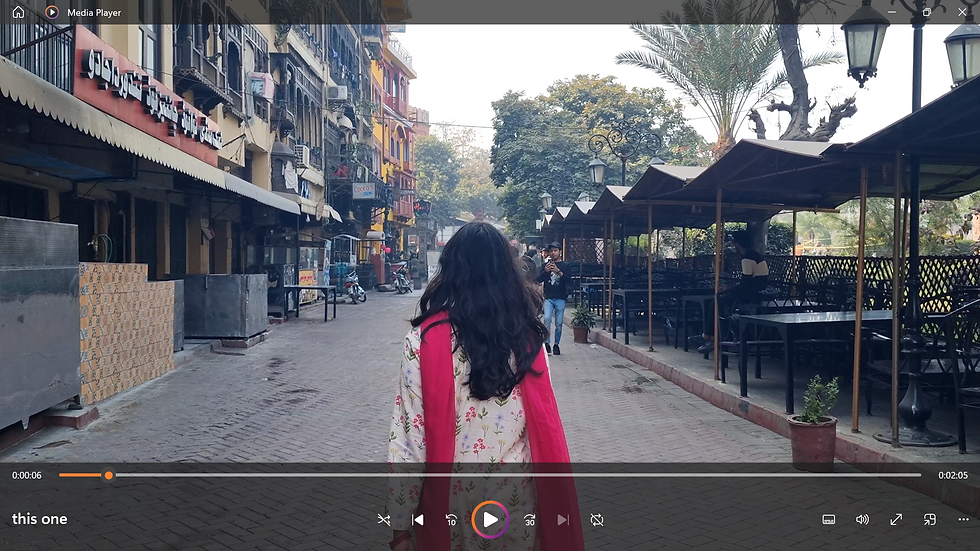
This became especially awkward as the guy also had his phone out, recording, which was... yeahhh, super weird, I know.
The sequence of the next four shots was well executed and well placed together, as they fit really well with one another and made a nice, pleasing-to-watch sequence. All these were shot in the same location, so placing them together wasn’t hard, and they flowed easily with one another.

When editing this cut, we had a sort of idea or plan to make this an abstract montage of sorts, instead of an abstract narrative like we did in the final cut. From here, we just proceeded with shots that flowed well together, looked good, and overall were just making us satisfied and happy, because all we had to show was the character wandering, looking around, as indeed this was her dream. We had all the advantages of doing whatever we wanted, editing the clips however we pleased, and then stating, "It's a dream, and dreams aren't cohesive."
This mentality proved to be beneficial, as this way there wasn’t the looming pressure about the clips fitting exactly, and we could experiment however we wanted. Actually, editing became so much more fun this way as well. We weren’t bound to locations either, as the character is supposed to be exploring, and we could play around with the location order. This is visible too, but not abrupt or awkward in the slightest.
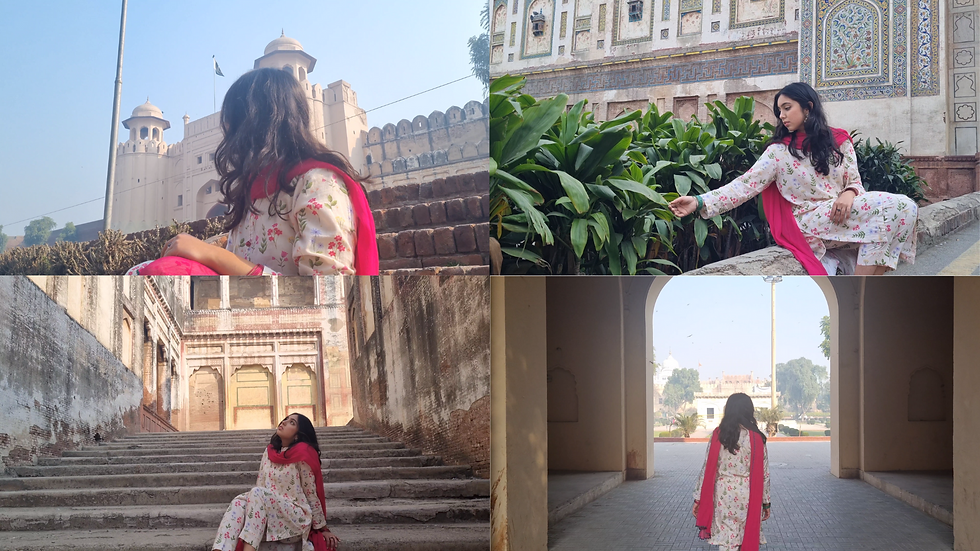
As in this 'exploring' sequence, the main subject is the character, and whatever the location, the shifts in those don't seem choppy or hard on the eyes at all. Even though the shots are entirely in focus, the main subject is still the girl.
The editing progressed like this, with us experimenting just based on what looked nice, which was, yes, actually harder as well and more time-consuming, and there wasn't a solid plan as to which clip would go before and which after. But this was more fun too, so I wouldn't complain.
Now, talking about the sound, we actually decided on the sound that exact day, when going to shot. We played different music options on the car Bluetooth, envisioning our shots, and then we decided on this perfect cultural music we found on YouTube.
This alone was perfect for our 'good part,' and after completing it entirely, we knew we just HAD to use the same for our final cut as well, as it was just that good.
Now, when we added the glitch, we used a glitch sound effect along with an intense dramatic sound that we wanted just before the waking-up scene to create that anticipation we wanted. Along with that, for the buildup, we also used a drumming sound that we gradually increased. We used the exact sound for the final cut as well, so all this will be in the Sound Mixing post.
So, after the transition to the now 'bad part,' we had the same technique of playing around with what looked best and what didn’t, but this was a bit more methodical, as this was the buildup part. We couldn’t use intense shots right at the beginning of the transition, as we needed to give our audience time to at least figure it out, or have it sink in that now we're trying to show something that is not quite in place. Because of this, we had to start with the significantly less intense and dramatic shots, and then gradually increase the suspense and intensity.
You might think it got easier this way, but it in fact did not, because for this part, we had to edit in a way that would create actual suspense, and choosing the right clips mattered so much more here.
We did pull through though (yay). With our final shot being a long take (which we later realized wasn't the best selection, as the quick cuts to suspense were automatically killed with the end long take—thank you to Sir Zia for pointing that out). But it wasn't bad.
We abruptly stopped our drums with the intense sound effect, and in the bedroom scene, we shifted back to the slow traditional music. It fit so well together, and the sound mixing I did, I was honestly so proud of it, because it sounded super cohesive.
And there it was. Our rough cut. We were honestly super duper proud of it, watched it several times in awe, and even showed our parents and relatives because we thought we did so well. And indeed we did. Good job to year-younger Zara and Rija!
Rough Cut:


Comments